2027 Salary Guide: Nearly 800 roles analysed across 29 sectors
The average salary across the 791 roles in the Alphéa Conseil 2027 salary grid stands at €35,700 gross per year , or approximately €2,975 gross and €2,320 net per month . This national benchmark conceals considerable differences: from €22,405 for a forklift truck driver to €107,500 for a managing director.
That is the problem with the averages published every year: they reassure everyone and help no one. There is no single French labour market, but dozens of markets that follow different rules. The 2027 Salary Guide was designed to move beyond this approximation.
Key salary figures for 2027:
- Median salary across all functions: €35,700 gross per year, or approximately €2,975 gross per month
- Lowest point in the grid: €22,405, the annualised French minimum wage (SMIC), which 16 roles are aligned with
- Highest point in the grid: €107,500 in general management
- Île-de-France premium compared with the national median: + 15%
- Premium for a group with more than 250 employees compared with an SME: + 13%
- Median salary increase budget anticipated for 2027: between 2.5% and 3%
- Scope: 791 roles, 29 sectors, data collected in August 2026

What the 2027 Salary Guide contains: 791 roles and 29 sectors
Each salary by role is expressed as annual gross pay, with its negotiation range: the format used in job adverts, and therefore the benchmark used in real-world discussions.
How much does a recruitment agency cost? Fees and charges 2026–2027
The 10 structural trends shaping businesses in 2026
2027 salaries by sector: median pay across seven major industries
2027 salaries in retail and distribution: the most compressed sector
“ In practice, the issue is almost never the starting salary. It is the gap with the person who is already there. When a department manager learns that a new starter is joining on the same pay, the question is no longer whether they are well paid: it is why they should stay. Many companies look at their salary grid when recruiting, whereas the real issue emerges in the six months that follow ”, says Rachida Tata , Managing Director of Alphéa Conseil.
2027 salaries in industry, maintenance and construction: shortages support skilled roles
2027 salaries in food manufacturing and agriculture: two worlds within one sector
2027 salaries in hospitality and catering: salary is no longer the main selling point
2027 salaries in healthcare and personal services: pressure that salary scales are not keeping pace with
Home care assistant: €23,300; healthcare assistant: €28,600; nurse: €33,900. This is one of the most recruitment-constrained sectors in France: more than one recruitment project in two is considered difficult according to
the 2026 Workforce Needs survey
by
France Travail
. Pay nevertheless remains constrained by
public funding
and
sector-wide collective agreements
. The pressure is real, but it does not automatically translate into higher salaries.
2027 salaries in property, banking and insurance: variable pay makes the difference
Property negotiator: €44,700; property adviser: €50,600; estate agency manager: €52,900. In banking, wealth manager: €49,100; bank branch manager: €59,100. These figures show base pay: in
property transactions
as in
wealth management
,
actual remuneration
depends on commission, which can double the pay gap between two professionals in the same role. This is the sector where comparing gross salaries makes the least sense without examining the remuneration structure.
2027 salaries in digital, IT and support functions: specialisation pays
Accountant: €36,000; developer: €39,100; management accountant: €41,100; IT project manager: €46,000; systems architect: €49,100. This is where internal differences are greatest: between a communications officer on €31,400 and an e-commerce manager on €42,100, the difference comes down to specialisation rather than length of service.
Cybersecurity
and
data remain the strongest
segments, with an IT security engineer on €44,700.
The guide covers all 791 roles, with a market benchmark, negotiation range and sector analysis for each one.
The guide covers all 791 roles, with a market benchmark, negotiation range and sector analysis for each one.
Pay transparency: why 2027 salary grids need to be reviewed
Three obligations change the way a salary grid should be built:
- The pay range will have to be communicated to the candidate before the interview, either in the job advert or before pay discussions begin.
- Employers will no longer be able to ask candidates about their current salary, a practice that mechanically reproduced existing pay gaps from one employer to another.
-
Employees will be able to request average remuneration levels for their category of role, broken down by sex.
This is why this guide publishes ranges rather than isolated figures. A defensible salary grid in 2027 is one in which each boundary can be explained by the scope of the role , rather than by the negotiating history of the person who holds it.
Gross, net, median: how to convert an annual gross salary into monthly net pay
The figures are annual gross amounts. To estimate monthly net pay, divide by 12 and then deduct employee social contributions: approximately 22% for a non-managerial employee and closer to 25% for a managerial employee , whose supplementary pension and unemployment insurance contributions are higher. Some useful conversions:
- €25,000 gross per year : approximately €1,625 net per month for a non-managerial employee
- €30,000 gross per year : approximately €1,950 net per month for a non-managerial employee
- €35,000 gross per year : approximately €2,275 net per month for a non-managerial employee
- €40,000 gross per year : approximately €2,500 net per month for a managerial employee
- €50,000 gross per year : approximately €3,125 net per month for a managerial employee
- €60,000 gross per year
: approximately €3,750 net per month for a managerial employee
These are medians, not averages. Half of open roles sit below this figure and half above it. The median salary is less distorted than the average salary, which can be pulled upwards by a small number of very high earners.
These are salaries offered at the point of recruitment , excluding bonuses and variable pay.
Why a starting salary is lower than the salary of someone already in the role
The mechanism is simple: a starting salary is an entry price, whereas the remuneration of an employee already in post reflects length of service , successive pay rises and variable pay . The gap reverses at the top of organisations, where an executive appointment is negotiated on entry rather than through annual pay reviews. It sheds light both on a company's difficulty retaining staff and on an employee's decision to look elsewhere.
Why two people in the same role do not earn the same salary
- Location: Based on the differences observed in the Alphéa Conseil 2027 salary grid , Île-de-France sits around 15% above the national median for an equivalent role.
- Company size and maturity: A group with more than 250 employees pays around 13% more than an SME for the same function.
- The actual scope of the role:
This is the most decisive and least visible factor. A quality manager overseeing three sites and a certification system is not doing the same job as a quality manager responsible for a single site, even if the job title and collective agreement are identical.
The size effect actually reflects three things. First, resources . A start-up and an established company do not operate on the same basis: the former often offsets a lower starting salary with greater autonomy, equity participation or faster progression, while the latter offers a higher level immediately but with more structured progression.
Second, the importance of the function within the business . The same function does not carry the same weight everywhere. A quality manager in a food-sector SME is central to the business model: without certification, there are no customers. The same profile in an organisation where quality is primarily an administrative requirement will be paid substantially less. Pay follows how critical the role is, not its title.
Finally, financial health . A profitable company pays better, but above all it pays differently: variable pay, profit-sharing and employee participation become meaningful components, whereas a business under pressure concentrates everything on fixed pay and keeps it as tight as possible. For commercial and management roles, this difference often represents several thousand euros a year that are invisible in the headline gross salary.
HR challenges, Training, Consulting and Support... Alphéa Conseil gives you advance access to all the latest news!
Follow us on LinkedIn

French minimum wage (SMIC) 2026: sixteen roles in the grid are paid at the minimum wage
In the 2027 grid, sixteen different roles are offered exactly at this level: cashier, sales adviser, shelf-stacking assistant, forklift truck driver, kitchen porter, school supervisor, among others . These roles have completely different requirements, working hours and responsibilities, yet the same starting salary.
This is one of the clearest findings from this edition. Across a significant part of the market, pay has ceased to differentiate jobs, and attractiveness is determined elsewhere: work organisation , consecutive days off , predictable rotas .
The limitations of a salary guide: collective agreements, total remuneration and local labour markets
They do not override sector-wide collective minimum rates, which may be higher than market rates and remain mandatory.
They do not measure total remuneration: health insurance, protection benefits, employee savings, profit-sharing and meal vouchers often represent several thousand euros that are not reflected in the headline gross salary.
Finally, these are national medians. In a tight local labour market or for a rare profile, the market rate can be negotiated significantly higher.
Methodology: how the 2027 salary figures were established
“ Poorly informed salary negotiations fail on both sides. The professional undersells themselves or asks for a level the role will never support, while the company discovers too late that its salary grid has fallen several thousand euros behind without anyone making a conscious decision. We prefer everyone to come to the table with the same figures: that is why we published this guide rather than keeping the data for our own assignments ”, explains Ludovic D'HOOGHE, Founder and CEO of Alphéa Conseil - Groupe Aquilion.
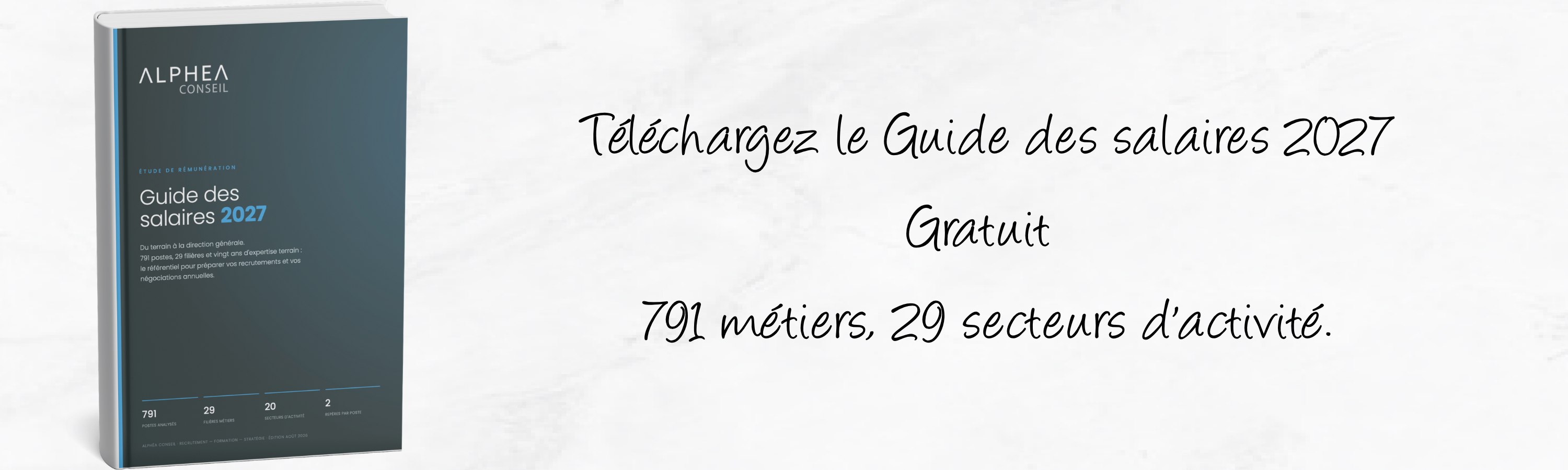
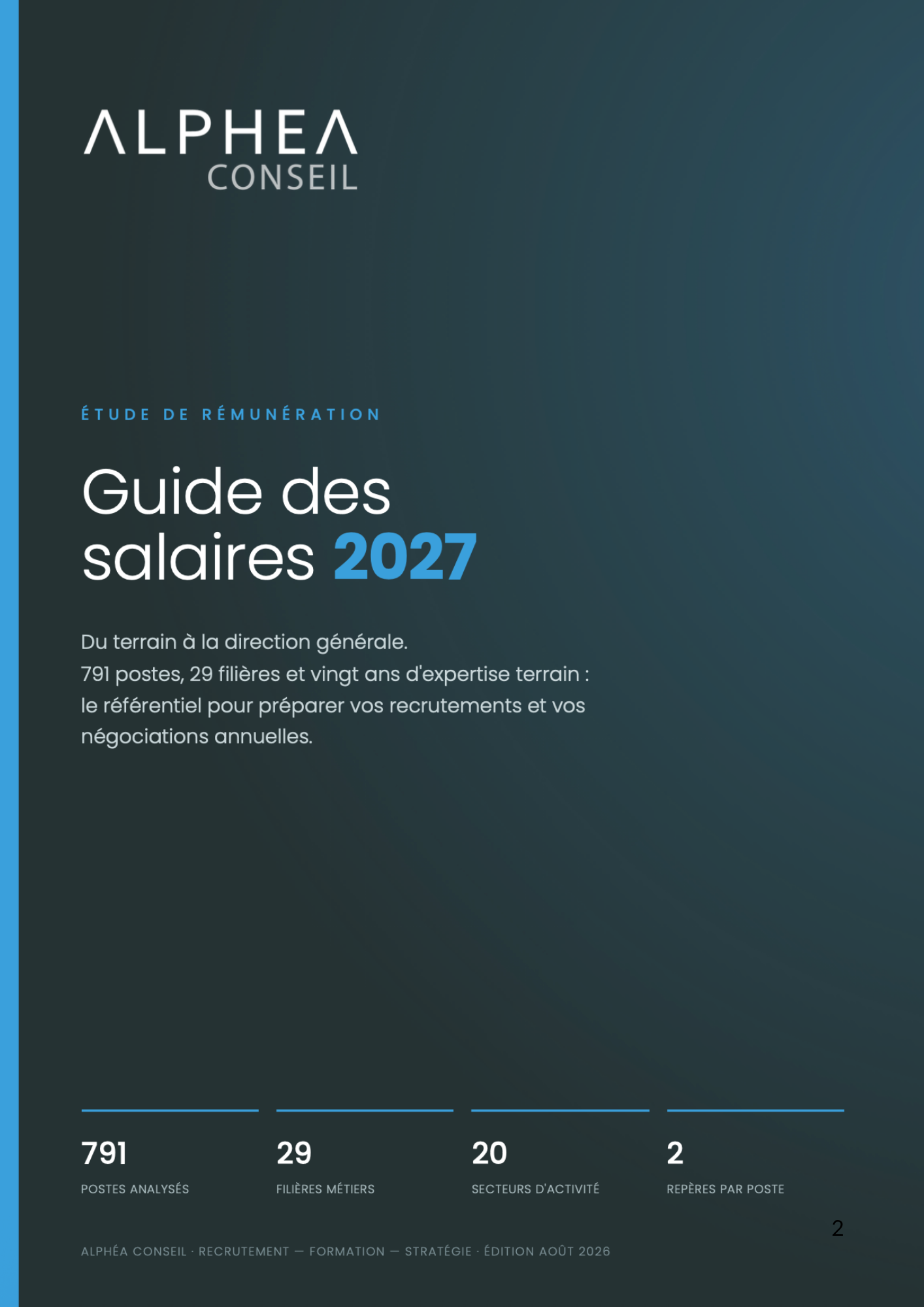
Download the 2027 Salary Guide - free, 791 roles, 29 sectors.
How to use a salary benchmark to prepare for a negotiation
To prepare for an interview, our consultants have compiled the 10 questions most frequently asked of managers in job interviews.
FAQ
1. What is the average salary in France in 2027?
2. What is the difference between an average salary and a median salary?
The average salary adds up all remuneration and divides it by the number of people: a small number of very high salaries can pull it upwards. The median salary divides the population into two equal halves, one above and one below. That is why this guide publishes medians: they better reflect the reality of a particular occupation.
3. What does €35,000 gross work out to net per month?
An annual gross salary of €35,000 corresponds to approximately €2,275 net per month for a non-managerial employee, before income tax is deducted at source. The calculation consists of dividing annual gross pay by 12 and then deducting employee social contributions: around 22% for a non-managerial employee and closer to 25% for a managerial employee, whose supplementary pension contributions are higher.
4. What is the French minimum wage (SMIC) in 2026?
The SMIC has been set at €12.31 gross per hour since 1 June 2026, equivalent to €1,867.02 gross per month for a full-time 35-hour week and €22,405 gross per year. This 2.41% increase was announced by the Government. On the basis of a 39-hour week, including the overtime premium, the minimum is around €2,130 gross per month.
5. How can you tell whether a salary is in line with the market?
Carry out three checks, in this order. First, use the benchmark for the precise role rather than the broader job family. Next, factor in region and company size: around 15% for Île-de-France and 13% for a group with more than 250 employees. Finally, consider the actual scope: number of people managed, budget responsibility and number of sites. A gap of less than 10% falls within the normal negotiation range.
6. What salary increase is realistic in 2027?
Converging sector barometers place the median salary increase budget between 2.5% and 3% for 2027, with a growing share of individual increases at the expense of general increases. This budget will not correct a market gap in a single year. Beyond that, the relevant argument is no longer length of service, but an increase in scope, a scarce skill in the local labour market or a documented gap with the market.
7. How do you build a salary grid for your company?
Two benchmarks are needed for each role: the salary offered on the recruitment market, which helps attract candidates, and the remuneration of people already in post, which helps retain them. Location and company-size adjustments are then applied, followed by a check of vertical consistency: when the gap between a management role and its team falls below 15%, internal promotion ceases to be attractive.
8. What does pay transparency change for salaries in 2027?
EU Directive 2023/970 requires employers to communicate a remuneration range to candidates before the interview, prohibits asking candidates about their current salary, and gives employees the right to information on average remuneration levels for their category of role, broken down by sex. It was due to be transposed into French law by 7 June 2026 and the process is still under way. In practical terms, every level in a salary grid will need to be justified using objective criteria.
Get a personalised salary benchmark for your key roles
Initial consultation with no obligation. Response within 24 working hours.