Quiz: Which management style suits you best?
The short quiz I am offering you below for the start of the new academic year will give you an idea of your dominant managerial profile, before we take things further together if you wish.”
The DISC method, my day-to-day tool at Alphéa Conseil
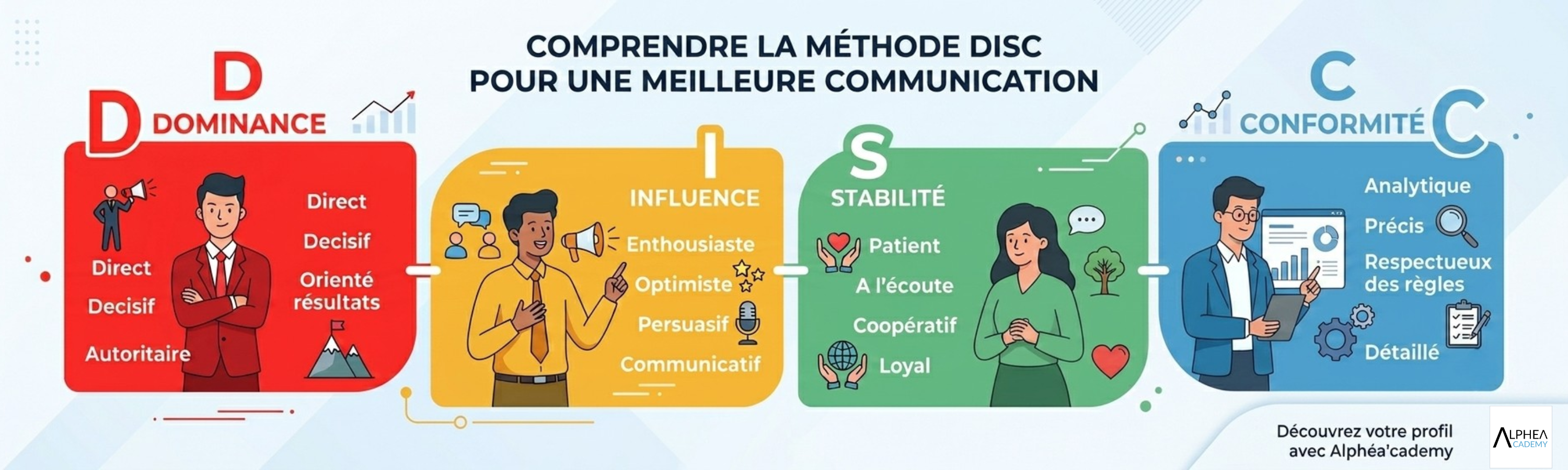
• The Red profile (Dominance): gets straight to the point: results-driven, makes decisions quickly, and can be directive under pressure.
• The Yellow profile (Influence): relies on relationships and enthusiasm, sometimes at the expense of following up on details.
• The Green profile (Steadiness): prioritises listening and cohesion, seeking consensus before making a final decision.
• The Blue profile (Conscientiousness): values rigour, even if it slows down decision-making to back it up with facts.
No profile is superior to the others: each has its strengths and blind spots depending on the context. This is precisely what I strive to convey when running DISC workshops, both internally and with our corporate clients: the goal is never to box anyone in, but to give them a better awareness of their natural reflexes so they can consciously adjust them when managing a team or facing a given situation.
At Alphéa Conseil , I do not view this method as just another training module. I use it to refine my understanding of both a candidate profile and a client company culture, and I regularly facilitate DISC workshops for my clients. Our training center Alphéa'Cademy , Qualiopi-certified , offers a certified DISC method training course that I help bring to life, open to directors and managers who want to lead their teams or recruit more effectively.
The DISC method: adapting your communication to perform.
Essential AI training courses for executives.
My Quiz: ten questions to identify your dominant style
Here is the quiz I usually offer in workshops, presented in a condensed format. For each of the following ten situations, note down the response that spontaneously sounds most like you, without overthinking it.
1. When facing a delayed project, you:
- (A) take control and reassign priorities immediately;
- (B) gather the team to boost motivation;
- (C) reassure everyone individually before adjusting the schedule;
- (D) analyze the precise causes of the delay first.
2. In a meeting, you are more likely to:
- (A) make quick decisions to move forward;
- (B) facilitate discussions and suggest ideas;
- (C) listen to everyone before speaking up;
- (D) prepare precise facts and figures in advance.
3. A team member makes a mistake: you
- (A) address it firmly and set a clear objective;
- (B) discuss it constructively while acknowledging their efforts;
- (C) take the time to understand what went wrong;
- (D) review the process step by step to identify the flaw.
4. You are notified of a sudden organizational change: you
- (A) immediately look for ways to turn it to your advantage;
- (B) discuss it openly to put things into perspective;
- (C) need time to adapt before getting on board;
- (D) ask for details regarding the exact logistics.
5. Your greatest professional pride stems mainly from:
- (A) results achieved against all odds;
- (B) a team you successfully motivated and brought together;
- (C) the lasting trust you inspire;
- (D) the quality and reliability of your work.
6. Under heavy pressure, you tend to:
- (A) become more directive;
- (B) talk more to release tension;
- (C) withdraw and avoid conflict;
- (D) focus heavily on controlling the details.
7. When dealing with a conflict between two colleagues, you:
- (A) resolve it quickly by setting a clear rule;
- (B) bring everyone together to defuse it through dialogue;
- (C) speak to each person individually to ease tensions;
- (D) establish the facts first.
8. For a major decision, you rely primarily on:
- (A) your instinct and speed of execution;
- (B) the enthusiasm of those around you at work;
- (C) finding a consensus;
- (D) a detailed analysis of the data.
9. A new team member arrives: you
- (A) set objectives for them quickly;
- (B) integrate them warmly into the group;
- (C) take the time to build a relationship of trust;
- (D) provide them with precise instructions.
10. What frustrates you most in a colleague is:
- (A) their slowness to act;
- (B) their lack of friendliness;
- (C) their aggressiveness or failure to listen;
- (D) their disorganisation or lack of rigour.
Here is the interpretation of your results and my coaching advice
Count your answers: a majority of
A
s indicates a
Red
tendency,
B
s a
Yellow
tendency,
C
s a
Green
tendency, and
D
s a
Blue
tendency. In the event of a tie between two letters, you likely combine two styles, which is very common and completely effective.
Majority of As: Red Profile (Dominance)
You lead through objectives and action. Your team appreciates your ability to make decisions, but may feel rushed if you do not explain them.
Majority of Bs: Yellow Profile (Influence)
You bring people together through enthusiasm and interpersonal skills—a real driver of engagement. The flip side is occasionally less rigorous follow-through on deadlines.
My advice for this profile:
I often recommend that these profiles pair up with a more methodical colleague to secure execution without losing that energy.
Majority of Cs: Green Profile (Steadiness)
You reassure others through active listening and consistency, which are invaluable during periods of change. What to watch out for: delaying uncomfortable decisions for the sake of group harmony.
My advice for this profile:
learning to make calls sooner will make you more effective without losing any of your listening skills.
Majority of Ds: Blue Profile (Conscientiousness)
You inspire confidence through your rigour and analytical quality. The risk, which I regularly highlight in sessions with this profile, is letting the search for a perfect decision delay a good one, especially in urgent situations.
This test is not a substitute for a full DISC assessment, but it provides a useful starting point to reflect on your managerial approach. The resulting profile is neither set in stone nor a label: it evolves with experience and context, and often combines with a secondary profile , which explains why two managers with the same dominant style can still lead very differently.
If you would like to take this further with an individual debrief or DISC coaching for your team, I would be delighted to discuss it with you.